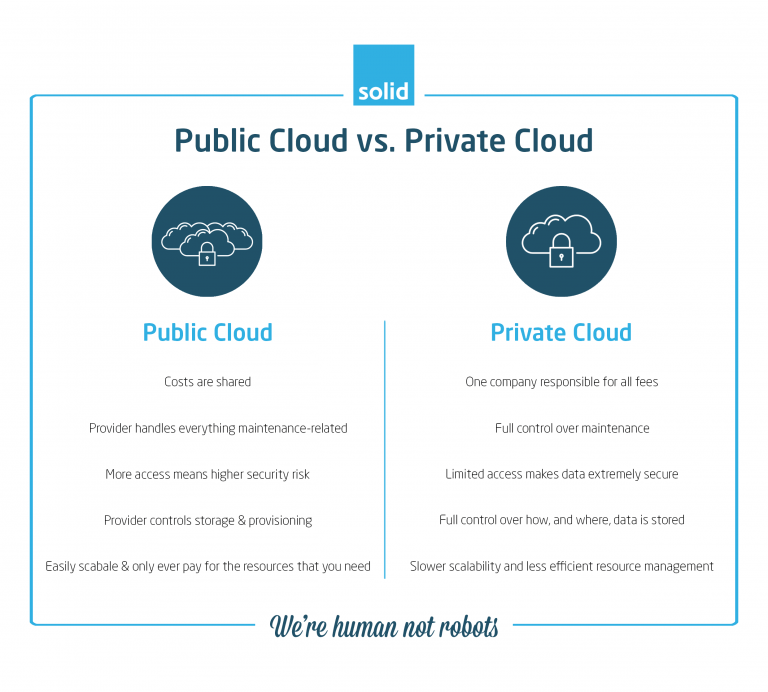
 Private Cloud Versus Public Cloud Comparison
The digital transformation era has made cloud computing a foundational element of modern business strategy. However, the critical decision facing organizations today is no longer if they should migrate to the cloud, but which cloud model best aligns with their unique operational, security, and financial requirements. The choice between a private cloud and a public cloud represents a fundamental strategic crossroads. This in-depth analysis moves beyond basic definitions to provide a comprehensive comparison of private and public cloud environments. We will explore their core architectures, dissect their advantages and limitations, analyze the total cost of ownership, and introduce the emerging paradigm of hybrid and multi-cloud strategies that are becoming the new standard for enterprise IT.
A. Foundational Definitions: Architecting Digital Environments
To understand the comparison, we must first establish a clear understanding of what each model entails in practice.
A. Public Cloud: The Shared Digital Metropolis
The public cloud is a model where computing services—servers, storage, networking, databases, analytics, and software—are delivered over the internet by third-party providers and shared across multiple organizations, known as “tenants.” It operates on a vast, multi-tenant architecture.
-
Key Providers: Amazon Web Services (AWS), Microsoft Azure, and Google Cloud Platform (GCP) are the dominant players.
-
Core Principle: Users consume resources on-demand from a virtually limitless pool, paying only for what they use, much like subscribing to a utility service like electricity.
-
Infrastructure Ownership: The cloud provider owns, manages, and maintains all hardware, software, and supporting infrastructure.
B. Private Cloud: The Secure Digital Fortress
A private cloud is a computing environment dedicated exclusively to a single business or organization. It can be physically located on the company’s own on-premises data center or hosted by a third-party provider. The key differentiator is its single-tenant nature.
-
Deployment Models:
-
On-Premises Private Cloud: Built and managed within an organization’s own data center using technologies like VMware vSphere, OpenStack, or Microsoft Azure Stack.
-
Hosted Private Cloud: Managed off-site by a specialized provider who dedicates infrastructure to a single client.
-
-
Core Principle: Offers the scalability and self-service benefits of cloud computing, but with the enhanced control and security of dedicated, isolated resources.
C. The Evolving Landscape: Hybrid and Multi-Cloud
Most modern enterprises are adopting blended approaches.
-
Hybrid Cloud: Integrates private and public clouds, allowing data and applications to be shared between them. This provides greater flexibility and deployment options.
-
Multi-Cloud: Involves using multiple public cloud services from different providers (e.g., using AWS for machine learning and Azure for Microsoft 365 integration), often to avoid vendor lock-in or leverage best-in-class services.
B. The Critical Trade-Off: A Detailed Comparative Analysis
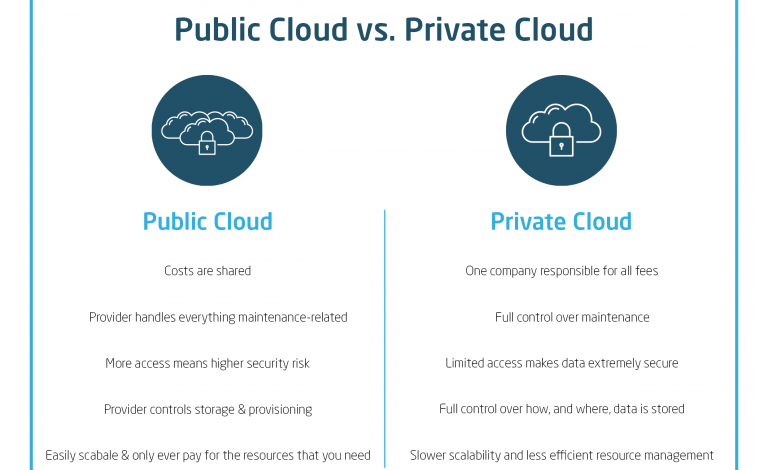
The choice between private and public cloud is not about which is universally better, but which is better for a specific set of needs. The decision revolves around a core trade-off between control and convenience.
A. Security, Compliance, and Data Sovereignty:
This is often the most significant deciding factor for regulated industries.
-
Private Cloud Advantages:
-
Dedicated Environment: Isolation from other organizations eliminates “noisy neighbor” security risks.
-
Granular Control: Organizations can implement custom security protocols, specific firewall rules, and tailored data governance policies.
-
Ideal for Compliance: Essential for industries with strict data privacy regulations like HIPAA (healthcare), FINRA (finance), and GDPR, where data residency must be guaranteed.
-
-
Public Cloud Advantages:
-
Provider Expertise: Cloud providers invest billions in global security infrastructure, threat intelligence, and expert security teams that would be cost-prohibitive for most single organizations.
-
Built-in Security Tools: Offers a vast array of native security services for encryption, identity and access management (IAM), and threat detection.
-
B. Cost Structure and Financial Implications:
The financial models are fundamentally different.
-
Public Cloud Cost Model (OpEx):
-
Pay-as-you-go: Converts capital expenditure (CapEx) to operational expenditure (OpEx). No upfront hardware costs; you pay only for consumed resources.
-
Economies of Scale: Leverages the provider’s massive scale to offer low per-unit costs.
-
Potential for Surprise Costs: Fees for data egress, API calls, and support can lead to “bill shock” if not carefully managed.
-
-
Private Cloud Cost Model (CapEx):
-
High Initial Investment: Requires significant capital expenditure for hardware, software licenses, and data center space.
-
Predictable Ongoing Costs: After the initial outlay, ongoing costs for maintenance and power are relatively predictable.
-
Cost-Effective for Predictable Workloads: For applications with steady, predictable resource demands, a private cloud can be more economical in the long run.
-
C. Performance, Customization, and Control:
-
Private Cloud Advantages:
-
Guaranteed Performance: Resources are not shared, ensuring consistent performance without contention from other tenants.
-
Deep Customization: The hardware and software stack can be tailored to the exact specifications of the workload, such as specific CPU types, memory configurations, or specialized storage arrays.
-
Full Administrative Control: IT teams have root-level access and complete command over the entire environment.
-
-
Public Cloud Advantages:
-
Massive Scalability (Elasticity): Resources can be scaled up or down almost instantly to handle unexpected traffic spikes.
-
Access to Cutting-Edge Innovation: Immediate access to the latest services in AI, machine learning, IoT, and serverless computing without any internal R&D investment.
-
D. Management and Operational Overhead:
-
Public Cloud Advantages:
-
Managed Services: The provider handles all patching, maintenance, and hardware failures. This frees up internal IT staff to focus on higher-value business projects.
-
Reduced Administrative Burden: No need for a large data center operations team.
-
-
Private Cloud Advantages:
-
Unified Management: Existing IT teams can manage the cloud with familiar tools and processes.
-
Direct Troubleshooting: Problems can be diagnosed and resolved directly without relying on a third-party support ticket system.
-

C. Strategic Implementation: Which Model is Right for Your Organization?
The optimal choice depends entirely on the nature of your business, workloads, and strategic goals.
A. Scenarios Favoring a Private Cloud Investment:
Organizations should strongly consider a private cloud when:
A. Operating in Heavily Regulated Industries: Healthcare, financial services, and government agencies that must meet strict compliance mandates.
B. Running Legacy or Custom Applications: Applications that require specific hardware, custom network configurations, or cannot be easily refactored for the public cloud.
C. Having Predictable, High-Volume Workloads: When resource demands are constant, the capital investment can be justified over a 3-5 year period.
D. Handling Highly Sensitive Intellectual Property: Where the risk of any external data exposure is unacceptable.
B. Scenarios Favoring a Public Cloud Adoption:
The public cloud is typically the best fit for:
A. Startups and Digital-Native Businesses: That need to scale rapidly without large upfront capital investment.
B. Workloads with Unpredictable Traffic: E-commerce websites, media streaming services, or SaaS applications that experience significant peaks and valleys.
C. Projects Requiring Advanced Technologies: Development teams that need to experiment with big data analytics, AI, or machine learning services.
D. Business Continuity and Disaster Recovery (DR): Provides a geographically diverse recovery site at a fraction of the cost of building a second private data center.
C. The Hybrid Cloud Imperative: The Best of Both Worlds
For most enterprises, a hybrid strategy is the answer. Common hybrid use cases include:
-
Cloud Bursting: Running an application primarily in a private cloud but “bursting” into the public cloud to handle peak demand.
-
Data Sovereignty and Processing: Storing regulated data in a private cloud while performing analytics on it in the public cloud.
-
Application Modernization: Running a legacy application in the private cloud while developing its modernized successor in the public cloud.
D. The Total Cost of Ownership (TCO) Deep Dive
A simplistic price comparison is misleading. A true TCO analysis must account for all direct and indirect costs over a 3-5 year period.
A. Public Cloud TCO Components:
-
Direct Costs: Compute instance fees, storage costs (hot, cool, archive), data transfer/egress fees, licensing fees, support plan costs.
-
Indirect Costs: Cloud management tool subscriptions, training for IT staff, potential costs of refactoring applications.
B. Private Cloud TCO Components:
-
Direct Capital Costs: Server hardware, networking switches, storage arrays, hypervisor software licenses, data center construction/rental.
-
Direct Operational Costs: Power and cooling, IT staff salaries for maintenance, hardware warranty renewals, software support contracts.
-
Indirect Costs: Cost of capital, opportunity cost of the initial investment, risk of hardware becoming obsolete.
C. The TCO Crossover Point:
There is a theoretical point where the ongoing OpEx of the public cloud surpasses the amortized CapEx of a private cloud for steady-state workloads. Identifying this crossover point is crucial for long-term financial planning.

E. Navigating the Future: Emerging Trends and Strategic Recommendations
The cloud landscape is not static. Strategic decisions must account for future developments.
A. The Rise of Industry-Specific Clouds: Public cloud providers are now offering compliant, tailored environments for specific verticals like healthcare (AWS HealthLake) and financial services (Azure Financial Services), blurring the lines between public and private benefits.
B. Edge Computing Integration: The growth of IoT is pushing computation to the “edge.” This creates a new distributed model where private edge locations interact seamlessly with centralized public or private clouds.
C. Containerization and Kubernetes: Technologies like Docker and Kubernetes are creating an abstraction layer that makes applications portable across private, public, and hybrid environments, reducing vendor lock-in and increasing deployment flexibility.
Strategic Recommendations for Decision-Makers:
A. Conduct a Thorough Application Assessment: Inventory all applications and categorize them based on their security, performance, and compliance needs.
B. Perform a Rigorous 5-Year TCO Analysis: Model the financial implications of both paths, including all hidden costs.
C. Start with a Hybrid Pilot: Begin by migrating a few non-critical applications to the public cloud while maintaining core systems in a private environment to build internal expertise.
D. Invest in Cloud Skills Development: Whether choosing private or public, ensure your IT team has the necessary skills to manage and optimize the chosen environment.
Conclusion: A Strategic Partnership, Not a Final Destination
The debate between private and public cloud is not a binary choice that ends with a single decision. Instead, it is an ongoing strategic balancing act. The modern enterprise technology landscape is inherently pluralistic, demanding a nuanced approach that leverages the strengths of each model. For most organizations, the future is a dynamic, integrated hybrid or multi-cloud architecture that allows them to place each workload in the optimal environment—balancing the unparalleled control and security of the private cloud with the explosive innovation and scalability of the public cloud. The most successful organizations will be those that master this balance, treating their cloud strategy not as a one-time project, but as a core, evolving competency that drives agility, resilience, and competitive advantage.