
Data Center Water Consumption Sustainability Solutions
In our increasingly digital world, data centers form the critical backbone of the global economy, powering everything from streaming video and social media to artificial intelligence and financial transactions. While much attention has been paid to their massive energy consumption and carbon footprint, a quieter, yet equally pressing, environmental challenge has emerged: their staggering water usage. As communities worldwide face growing water scarcity, the technology industry’s reliance on this precious resource for cooling its massive computing infrastructure is coming under intense scrutiny. This comprehensive analysis delves into the complex relationship between data centers and water, exploring the scale of consumption, the innovative technologies revolutionizing cooling efficiency, and the strategic roadmap the industry is adopting to achieve a more sustainable, water-resilient future.
A. The Hidden Thirst: Understanding Data Center Water Consumption
The incredible computational power within a data center generates immense heat. If not managed effectively, this heat can damage sensitive components and cause catastrophic failures. Water has emerged as the dominant medium for heat rejection due to its exceptional thermal properties.
A. The Primary Driver: Cooling System Demands
The vast majority of water consumed by data centers is used for cooling. This occurs primarily through two methods:
-
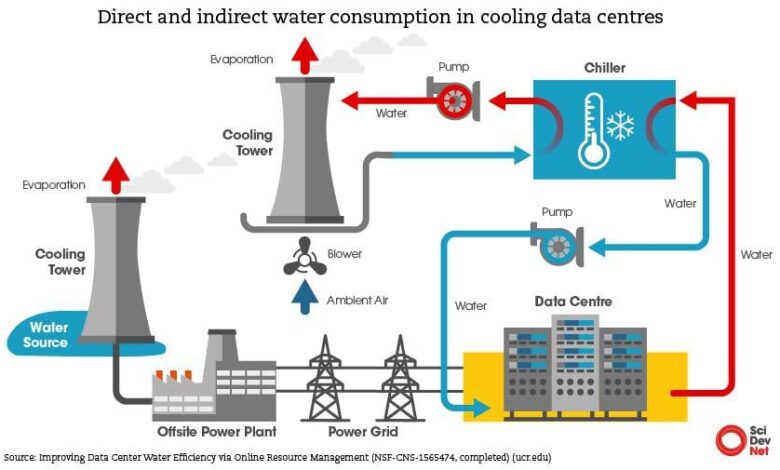
Evaporative Cooling Towers: These are the most common and water-intensive systems. Hot water from the data center’s cooling loop is sprayed into a tower, where a fraction of it evaporates, removing a significant amount of heat. The evaporated water is lost to the atmosphere, while the cooled water is recirculated. This process consumes millions of gallons of water annually per facility.
-
Chiller Systems: While more energy-intensive, chillers can use less water in a closed-loop system. However, they often still rely on cooling towers to reject heat from the condenser loop, leading to evaporative losses.
B. The Critical Metric: Water Usage Effectiveness (WUE)
To measure and manage their impact, the industry uses a metric called Water Usage Effectiveness (WUE). Introduced by The Green Grid consortium, WUE is calculated as:
WUE = Total Site Water Usage / IT Equipment Energy Usage
The unit is liters per kilowatt-hour (L/kWh). A lower WUE indicates a more water-efficient facility. While PUE (Power Usage Effectiveness) has been the standard for energy efficiency, WUE is rapidly gaining prominence as a key sustainability indicator.
C. The Scale of the Challenge: Quantifying Global Consumption
A single hyperscale data center campus can consume between 1 to 5 million gallons of water per day—equivalent to the water usage of a city of 50,000 people. As the demand for cloud computing, AI, and data storage continues its exponential growth, so too does the collective water footprint of the thousands of data centers operating globally. This places them in direct competition with agricultural and municipal needs, particularly in water-stressed regions.
B. Beyond the Data Hall: Indirect Water Usage and the Full Footprint
A complete understanding of data center water usage requires looking beyond the cooling towers to the entire value chain.
A. Water for Power Generation (Scope 2 Emissions):
This is often the largest component of a data center’s indirect water footprint. The generation of electricity, whether from fossil fuels, nuclear, or even some solar thermal plants, requires vast quantities of water for steam generation and cooling. A data center powered by a coal or nuclear plant is indirectly responsible for the massive water consumption of that power station.
B. Supply Chain and Manufacturing (Scope 3 Emissions):
The manufacturing of IT hardware—servers, networking gear, and chips—is an extremely water-intensive process. Semiconductor fabrication requires ultra-pure water for rinsing silicon wafers. The full lifecycle water cost of a single server, from its production to its decommissioning, adds a significant, though often unaccounted for, layer to the data center’s total water impact.
C. The Innovation Frontier: Water-Efficient and Water-Free Cooling Technologies
Facing public pressure and operational risks, the industry is pioneering a new generation of cooling technologies designed to drastically reduce or eliminate potable water consumption.
A. Air-Side Economization: Harnessing the Environment
This is the most widespread method for reducing water usage. It involves using outside air to cool the data center directly, instead of relying on mechanical chillers and cooling towers.
-
Direct Air-Side Economization: Cool, dry outside air is filtered and pumped directly into the data hall. This works exceptionally well in climates like the Pacific Northwest, Ireland, and Scandinavia.
-
Indirect Air-Side Economization: Outside air cools an internal air loop through a heat exchanger, protecting the IT equipment from contaminants and humidity fluctuations. This allows for deployment in a wider range of climates.
B. Liquid Cooling: The New Gold Standard for High-Density Computing
As server chips become more powerful, especially with the rise of AI, air cooling is reaching its physical limits. Liquid cooling, which is far more efficient, is emerging as the solution.
-
Direct-to-Chip Cooling: Cold plates are attached directly to high-heat components like CPUs and GPUs. A fluid circulates through the plates, capturing heat with incredible efficiency and using a fraction of the water and energy of traditional systems.
-
Immersion Cooling: This revolutionary approach involves submerging entire servers in a non-conductive, non-flammable dielectric fluid. The fluid boils off the components, and the vapor is condensed back into liquid in a closed loop. This system uses zero water for cooling and can reduce a server’s energy consumption by up to 40%.
C. Advanced Design and Waste Heat Recycling
Innovative data center designs are turning waste into a resource.
-
Waste Heat Recycling: Instead of rejecting heat as a waste product, some facilities are capturing it and selling it to district heating networks to warm nearby homes, offices, and greenhouses. This improves the overall energy and water efficiency of the community.
-
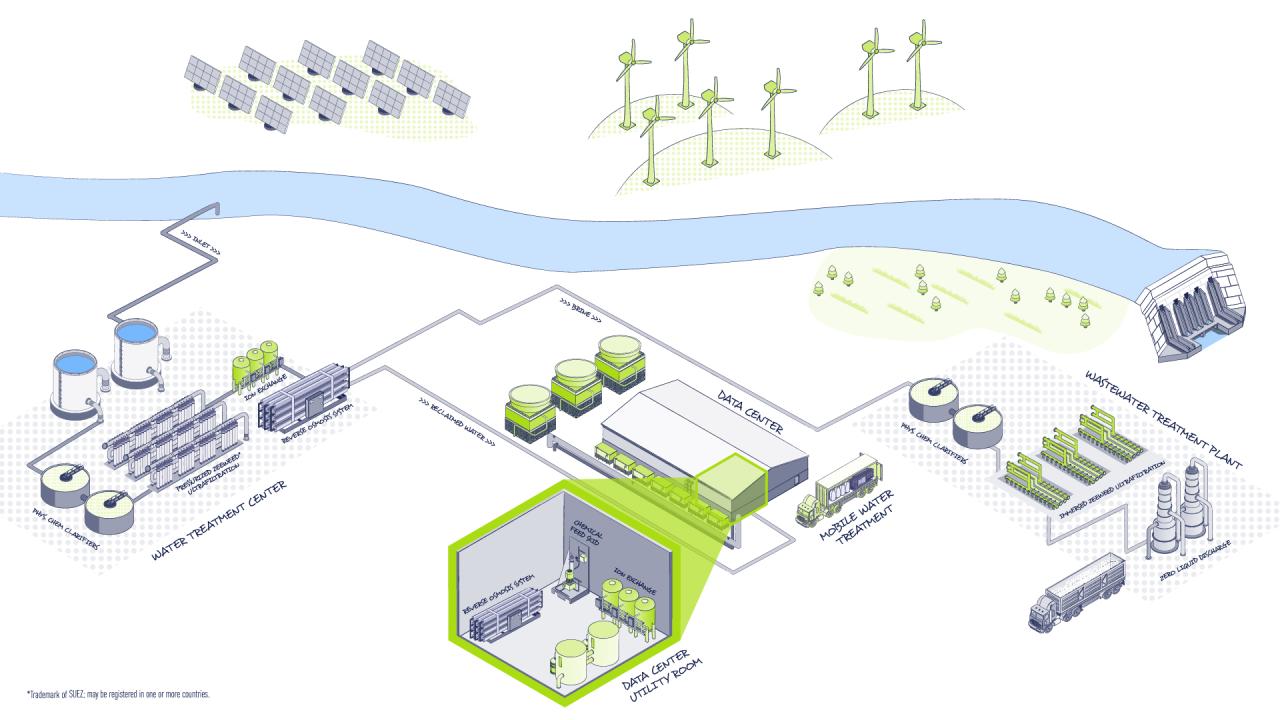
Saline or Reclaimed Water Use: Cutting-edge data centers, particularly those built by Microsoft and Google, are being designed to use non-potable water sources. This includes treated wastewater (reclaimed water) or even seawater for cooling, preserving precious freshwater resources for communities.

D. Industry Leaders: Case Studies in Water Stewardship
The hyperscale cloud providers are leading the charge, making ambitious public commitments and deploying groundbreaking technologies.
A. Google’s Climate-Conscious Computing:
Google has set a target to replenish 120% of the freshwater it consumes by 2030 and is developing a “watershed-centric” approach to data center placement and operation. The company uses sophisticated AI to optimize its cooling systems in real-time, choosing the most water-efficient method based on current weather conditions.
B. Microsoft’s Liquid Immersion and R&D Focus:
Microsoft has been a pioneer in testing two-phase immersion cooling in production environments. Their Project Natick, which deployed a sealed data center capsule on the seafloor, demonstrated the ultimate in water-free, energy-efficient cooling and reliability. They are also investing heavily in R&D for next-generation cooling technologies.
C. Meta’s (Facebook) Advanced Evaporative and Air Cooling:
Meta’s data centers consistently achieve industry-leading low WUE scores. Their facility in Altoona, Iowa, uses 100% outside air cooling for 70% of the year and employs highly efficient evaporative cooling systems when necessary, setting a benchmark for sustainable design in variable climates.
E. The Strategic Imperative: A Multi-Pronged Approach to Water Resilience
For data center operators, reducing water usage is no longer optional. It is a strategic necessity for risk management, cost control, and maintaining their social license to operate.
A. Strategic Geographic Siting:
The most effective water-saving strategy is location. Building new data centers in cooler, water-rich climates with access to renewable energy inherently reduces their water footprint. However, latency requirements and internet backbone proximity often dictate location, making technological solutions all the more critical.
B. Transparent Reporting and Goal Setting:
Stakeholders, including investors, customers, and local communities, are demanding greater transparency. Operators must publicly report their WUE metrics and set ambitious, time-bound goals for water reduction and replenishment.
C. Water Positivity and Replenishment Projects:
Following Google’s lead, the concept of “water positivity” is gaining traction. This involves investing in local water restoration projects—such as recharging aquifers, restoring wetlands, and improving agricultural irrigation—that return more water to a watershed than the data center consumes.
D. Government Regulations and Community Relations:
Municipalities and states are beginning to scrutinize data center water permits more closely. Proactive engagement with local water authorities and communities, along with a demonstrable commitment to conservation, is essential for securing approval for new facilities and expansions.
F. The Future of Data Center Cooling: A Roadmap to 2030
The trajectory of data center cooling is clear: a decisive move away from evaporative water consumption.
A. The Proliferation of Liquid Cooling:
Driven by the AI boom, liquid cooling will transition from a niche solution for high-performance computing to a mainstream technology. Within the next decade, it is expected to become the standard for all high-density server racks.
B. The Rise of “Water-Aware” AI and Control Systems:
AI will not only be a driver of demand but also a key part of the solution. Smarter control systems will dynamically manage resources, automatically switching between cooling modes (air, liquid, minimal water) to optimize for the lowest possible WUE in real-time.
C. Closed-Loop Systems and Advanced Heat Reuse:
The ideal of a fully closed-loop data center—one that uses zero water for cooling and finds productive uses for its waste heat—will become a primary design goal for new builds. Integration with district energy systems will become a standard consideration in urban planning.
Conclusion: Towards a Water-Smart Digital Future
The challenge of data center water usage is a microcosm of a larger global imperative: to reconcile our technological advancement with the planet’s finite resources. The industry stands at a pivotal moment. The path forward requires a fundamental shift from viewing water as a cheap and abundant cooling input to treating it as a scarce, shared, and vital resource. Through a combination of technological innovation, strategic location planning, transparent governance, and proactive community partnership, data centers can transform from being part of the water problem to becoming leaders in the solution. The future of our digital world depends not just on faster processors and larger storage, but on a commitment to building an infrastructure that is not only smart and powerful but also sustainable and responsible. The journey to a water-resilient digital economy has already begun, and its success is critical for the long-term health of both our online and natural worlds.