
A. Introduction: Navigating the Virtual Private Server Landscape in 2024
In the dynamic world of web hosting, the quest for the perfect balance between performance, control, and affordability leads countless businesses and developers to a singular solution: Virtual Private Server (VPS) hosting. As we navigate through 2024, the VPS market is more competitive and sophisticated than ever, offering an array of options that cater to everything from nascent blogs to enterprise-level applications. However, this abundance of choice also presents a significant challenge: how does one identify the truly best VPS provider for their specific needs? This exhaustive guide is designed to be your definitive resource. We will dissect the top VPS providers of 2024, providing a detailed, analytical comparison based on performance, features, pricing, and support. Our goal is to empower you with the knowledge to move beyond marketing hype and make a strategically sound investment that will power your online presence for years to come.
A VPS occupies a crucial middle ground in the hosting spectrum. It offers the dedicated resources and root access of a private server, without the exorbitant cost and complexity of a dedicated physical machine. By leveraging virtualization technology, a single powerful server is partitioned into multiple isolated virtual environments, each functioning as a fully independent unit. This guide will not only list providers but will also equip you with a framework for evaluation, ensuring you select a host that aligns perfectly with your technical requirements and growth trajectory.
B. Critical Evaluation Criteria for Selecting a VPS Provider
Before delving into specific providers, it is imperative to establish the key metrics upon which they should be judged. Understanding these criteria will allow you to conduct your own informed comparisons long after reading this article.
A. Performance and Hardware Specifications
The raw power of your VPS is the foundation of your website’s speed and responsiveness.
-
CPU (vCPU/CPU Cores): Look for providers offering modern, high-clock-speed CPUs (e.g., AMD EPYC or Intel Xeon). Understand the difference between shared, burstable, and dedicated vCPUs.
-
RAM (Memory): Ensure there is an adequate amount of RAM for your applications. Swapping to disk (using SSD as virtual RAM) is a major performance killer.
-
Storage Type and Speed: NVMe SSDs are the undisputed king in 2024, offering read/write speeds that are multiple times faster than traditional SATA SSDs. This is critical for database performance and overall I/O operations.
-
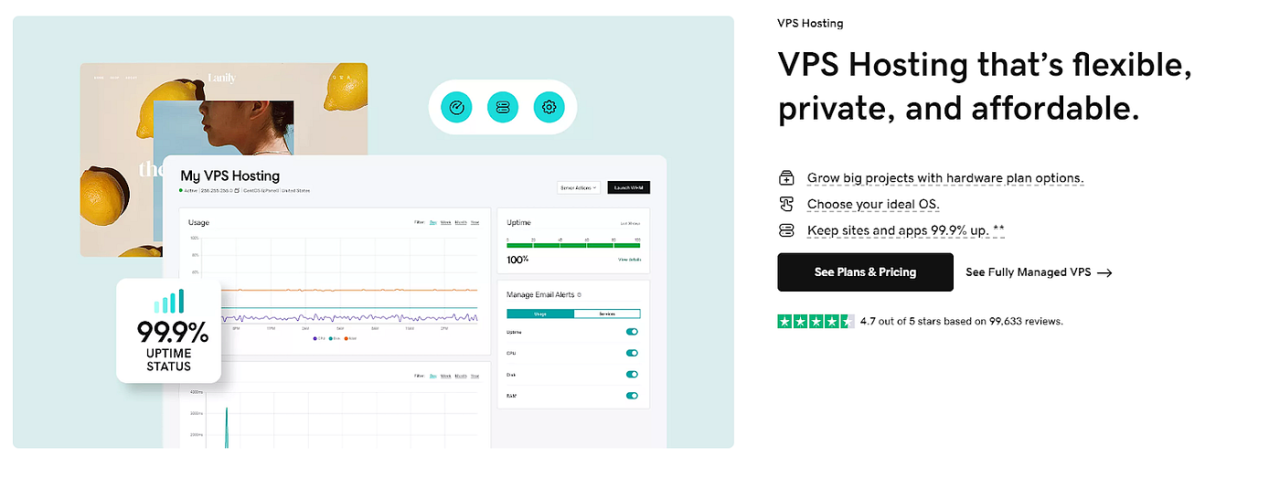
Network Uptime and Speed: A 99.9% uptime guarantee is standard, but many top-tier providers offer 99.99% or higher. Look for providers with high-speed network backbones (1 Gbps+).
B. Pricing Structure and Overall Value
The cheapest option is rarely the best value.
-
Transparent Pricing: Be wary of hidden fees for setup, backups, or control panels.
-
Hourly vs. Monthly Billing: Flexible billing allows you to test services or run short-term projects cost-effectively.
-
Money-Back Guarantee: A robust guarantee (30-day is common) provides a risk-free trial period.
C. Scalability and Future-Proofing
Your hosting should be able to grow with your business.
-
Ease of Upgrading: Can you seamlessly upgrade your CPU, RAM, or storage with minimal to no downtime?
-
Cloud Infrastructure: Providers built on a true cloud platform (like AWS, Google Cloud, or a proprietary cloud) typically offer the most effortless scaling capabilities.
D. Feature Set and Control Panel Options
The included features can save you significant time and money.
-
Managed vs. Unmanaged: Managed VPS includes server administration, security patching, and troubleshooting. Unmanaged is cheaper but requires advanced sysadmin skills.
-
Control Panels: Is a control panel like cPanel, Plesk, or Webmin included in the price, or is it an expensive add-on?
-
Backup Solutions: Are automated, off-server backups available? How much do they cost?
-
Operating System Choices: A wide selection of Linux distributions (Ubuntu, CentOS, Debian) and Windows Server versions is a major plus.
E. Customer Support and Global Infrastructure
When something goes wrong, support is your lifeline.
-
Support Channels: 24/7 support via live chat, phone, and ticket is ideal.
-
Expertise: Test their support with pre-sales questions to gauge response time and knowledge.
-
Data Center Locations: Multiple global data center options allow you to host your server closer to your target audience, reducing latency.
C. In-Depth Analysis of the Top VPS Providers for 2024
Based on the criteria above, here is a detailed breakdown of the leading VPS providers in the current market.
A. DigitalOcean: The Developer’s Darling
DigitalOcean revolutionized the VPS space with its simplicity and predictable pricing. Its droplets are a favorite among developers and startups.
-
Strengths: Exceptionally user-friendly interface, straightforward and transparent pricing, extensive documentation and community tutorials, excellent API for automation, consistent performance.
-
Considerations: Less suited for traditional shared hosting migrants who rely on cPanel; more focused on developers and tech-savvy users.
-
Ideal For: Developers, startups, SaaS companies, and anyone deploying applications using modern stacks like Node.js, Python, Ruby, or Docker.
-
Pricing Example: Their basic droplet starts at $4/month for 1 vCPU, 512MB RAM, and 10GB SSD.
B. Vultr (Now owned by Constant): The Performance Powerhouse
Vultr is a fierce competitor known for its high-performance compute instances and vast global presence. They consistently rank high in independent performance benchmarks.
-
Strengths: Raw performance, especially with their High Frequency compute instances, an enormous number of data center locations (over 30), flexible deployment options including bare metal, simple and competitive pricing.
-
Considerations: Similar to DigitalOcean, it is geared towards users comfortable with server administration.
-
Ideal For: Performance-critical applications, gaming servers, global deployments requiring low latency, and users who need a specific geographic location.
-
Pricing Example: High Frequency instances start at $6/month for 1 vCPU, 1GB RAM, and 32GB NVMe SSD.
C. Linode (Now part of Akamai): The Established Veteran
Recently acquired by cloud giant Akamai, Linode brings years of reliability and a robust feature set to the table. It is a trusted name with a strong track record.
-
Strengths: Proven reliability and stability, a comprehensive suite of add-on services (Object Storage, NodeBalancers), excellent network performance backed by Akamai’s global backbone, strong documentation.
-
Considerations: The interface, while powerful, can feel slightly less modern than some competitors.
-
Ideal For: Businesses looking for a reliable, full-featured cloud platform, those who need integrated load balancers and object storage, and users who value long-term stability.
-
Pricing Example: Shared CPU instances start at $5/month for 1 vCPU, 1GB RAM, and 25GB SSD.
D. Kamatera: The Enterprise-Grade Contender
Kamatera offers a massive, scalable cloud infrastructure that appeals to both small businesses and large enterprises. Their flexibility is a key selling point.
-
Strengths: Highly customizable VPS configurations (you can fine-tune CPU, RAM, and SSD), a massive global network of data centers, offers both Linux and Windows cloud servers, load balancer and firewall services included.
-
Considerations: The vast number of options can be overwhelming for beginners. Pricing requires careful configuration to understand the final cost.
-
Ideal For: Enterprises, growing businesses with specific resource requirements, and IT managers who need full control over their server specs.
-
Pricing Example: Pricing is highly configurable, starting as low as $4/month for a basic instance.
E. Hostinger: The Budget-Friendly All-Rounder
Hostinger has made a name for itself by offering incredibly affordable VPS plans without completely sacrificing performance, making it a great entry-point.
-
Strengths: Unbeatable low prices, user-friendly custom control panel, includes a dedicated IP address, 24/7 support, and a 30-day money-back guarantee.
-
Considerations: The base-tier resources are limited, and the performance, while good for the price, may not match the raw power of DigitalOcean or Vultr.
-
Ideal For: Beginners, small business websites, developers on an extreme budget, and those migrating from shared hosting who want a familiar management panel.
-
Pricing Example: VPS 1 plan starts at an astonishingly low $3.49/month for 1 vCPU, 1GB RAM, and 20GB SSD.
F. ScalaHosting: The cPanel Alternative Leader
ScalaHosting stands out with its innovative SPanel, a fully-featured control panel that is offered for free as a direct alternative to the increasingly expensive cPanel.
-
Strengths: Cost savings from the free SPanel, managed VPS services included by default, proprietary SShield security AI that blocks 99.998% of web attacks, excellent customer support.
-
Considerations: Their ecosystem is best experienced holistically; the full benefit is realized by using their SPanel and security tools together.
-
Ideal For: Agencies, web professionals, and businesses looking to escape cPanel licensing fees and who value managed security and support.
-
Pricing Example: Managed VPS Start plan begins at $29.95/month for 2 CPU cores, 4GB RAM, and 50GB SSD.
D. Specialized VPS Hosting Niches
Beyond the general-purpose providers, certain hosts excel in specific areas.
A. For Managed VPS Services
If you lack system administration skills, a managed VPS is essential.
-
Cloudways: A unique platform that provides managed services on top of infrastructure from DigitalOcean, Linode, Vultr, AWS, and Google Cloud. It offers an intuitive interface, automated backups, and built-in caching.
-
WP Engine: While specifically for WordPress, it represents the pinnacle of managed hosting with expert support, optimized stacks, and robust staging environments.
B. For Windows VPS
If your applications require the Windows Server operating system.
-
Kamatera: Offers a wide range of Windows Server versions with licensed images available.
-
Liquid Web: Known for its premium managed hosting, including robust Windows VPS solutions with Plesk control panel.
C. For Cheap VPS Trials
-
Hostinger and DigitalOcean (with its free credit offers for new users) are excellent choices for those who want to test the waters with minimal financial commitment.
E. A Strategic Decision Framework: How to Make Your Final Choice
To synthesize this information, follow this step-by-step decision process:
A. Step 1: Assess Your Technical Proficiency
-
Beginner/No Sysadmin Skills: Prioritize Managed VPS providers like ScalaHosting, Cloudways, or the managed options from traditional hosts.
-
Intermediate/Expert Developer: You have the freedom to choose unmanaged providers like DigitalOcean, Vultr, or Linode for better performance and cost-efficiency.
B. Step 2: Define Your Performance and Budget Requirements
-
Budget-Conscious, Standard Workloads: Hostinger offers the best entry point.
-
Performance-Critical Applications: Vultr High Frequency or DigitalOcean Premium droplets are superior.
-
Need Customizable Resources: Kamatera provides the most flexibility.
C. Step 3: Consider Your Required Feature Set
-
Need a Traditional Control Panel (cPanel/Plesk): Factor in the additional cost ($15-20/month) if using an unmanaged provider, or choose ScalaHosting for free SPanel.
-
Require Specific Global Locations: Vultr and Linode have extensive global networks.
-
Need Integrated Backups, Load Balancers, Object Storage: Linode and DigitalOcean have robust, native add-ons.
D. Step 4: Plan for the Future
-
Choose a provider that makes it easy to scale your resources vertically (upgrading your plan) or horizontally (adding more servers). All the cloud-native providers (DO, Vultr, Linode, Kamatera) excel here.
F. Conclusion: Empowering Your Digital Journey with the Right VPS
The “best” VPS provider is not a universal constant; it is a variable defined by your unique project requirements, technical expertise, and financial constraints. In 2024, the market offers a stellar array of options, from the developer-centric power of DigitalOcean and Vultr to the user-friendly, value-packed offerings of Hostinger and ScalaHosting.
By moving beyond price alone and critically evaluating performance, features, support, and scalability, you can select a VPS partner that will not only host your website but will actively contribute to its success. The investment in time you make now to choose wisely will pay dividends in site stability, user satisfaction, and peace of mind for the long term. Take advantage of money-back guarantees and free trials to test your shortlisted providers, and embark on your 2024 digital journey with a hosting foundation you can truly rely on.