A. The Startup Conundrum: Building More with Less
In the high-stakes arena of startups, where speed to market, operational agility, and capital efficiency are the difference between success and obscurity, technology decisions carry an immense weight. The traditional approach of provisioning and managing servers—whether physical or virtual—creates a significant operational overhead that can stifle innovation and drain precious resources. This is where Serverless Architecture emerges as a transformative paradigm, offering a compelling solution to the core challenges faced by early-stage companies. Far from meaning “without servers,” serverless computing refers to a model where the cloud provider dynamically manages the allocation and provisioning of servers. Developers simply deploy their code in the form of functions, which are executed in response to events, without ever worrying about the underlying infrastructure. This in-depth guide will explore the profound advantages of serverless architecture for startups, providing a strategic blueprint for leveraging this technology to accelerate development, minimize costs, and build scalable, resilient products from day one.
The serverless model represents a fundamental shift from a “server-centric” to a “code-centric” worldview. For a startup, this means the team can focus exclusively on writing business logic that delivers unique value to customers, while outsourcing the undifferentiated heavy lifting of server management, patching, scaling, and capacity planning to cloud giants like AWS, Google Cloud, and Microsoft Azure. We will dissect the economic, technical, and operational benefits, address common misconceptions and challenges, and provide a practical framework for startups to begin their serverless journey.
B. Deconstructing Serverless Computing: Core Concepts and Components
To appreciate its value, one must first understand the core principles and building blocks that constitute a serverless architecture.
A. The Foundation: Function-as-a-Service (FaaS)
At the heart of serverless is FaaS. Developers write discrete, single-purpose functions—small units of code designed to perform a specific task.
-
Event-Driven Execution: These functions lie dormant until triggered by a specific event. This event could be an HTTP request, a new file uploaded to cloud storage, a new record in a database, a scheduled time, or a message in a queue.
-
Statelessness: Each function execution is typically stateless. Any required state must be stored in an external service like a database or cache.
-
Key Providers: AWS Lambda is the market leader, but alternatives include Google Cloud Functions, Microsoft Azure Functions, and IBM Cloud Functions.
B. The Supporting Cast: A Serverless Ecosystem
A serverless application is rarely just functions. It is a symphony of managed services:
-
API Gateway: Serves as the front door, accepting HTTP requests and routing them to the appropriate serverless function. It handles tasks like authentication, rate limiting, and request transformation.
-
Managed Databases: Services like Amazon DynamoDB (NoSQL) or Aurora Serverless (SQL) provide databases that automatically scale capacity up and down based on demand, with a pay-per-request pricing model.
-
Event Sources: These are the triggers for your functions. Examples include Amazon S3 (for file uploads), Amazon SNS/SQS (for message passing), and CloudWatch Events (for scheduling).
-
Frontend Hosting: Static websites and single-page applications (SPAs) can be hosted cost-effectively on Amazon S3 and distributed via CloudFront, a Content Delivery Network (CDN).
C. The Multifaceted Advantages for Startup Survival and Growth
The serverless model aligns perfectly with the needs of a resource-constrained, fast-moving startup.
A. Radical Cost Efficiency and the Pay-Per-Use Model
This is arguably the most significant advantage. Serverless follows a true pay-as-you-go pricing model.
-
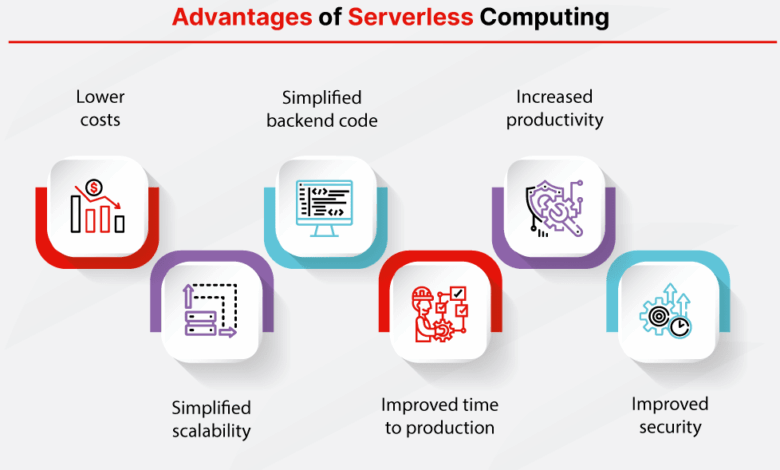
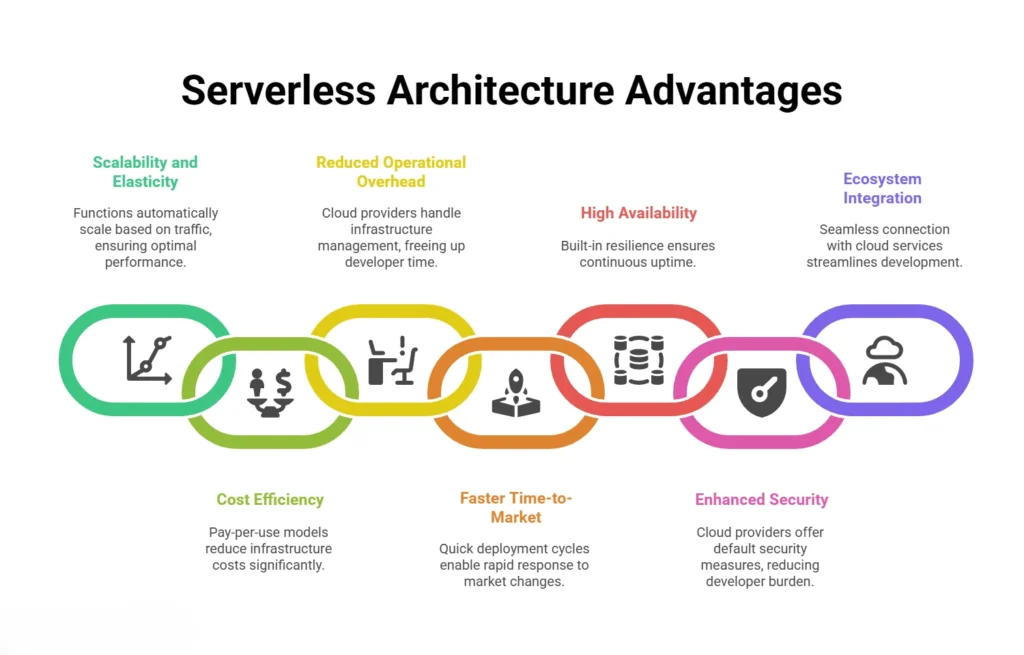
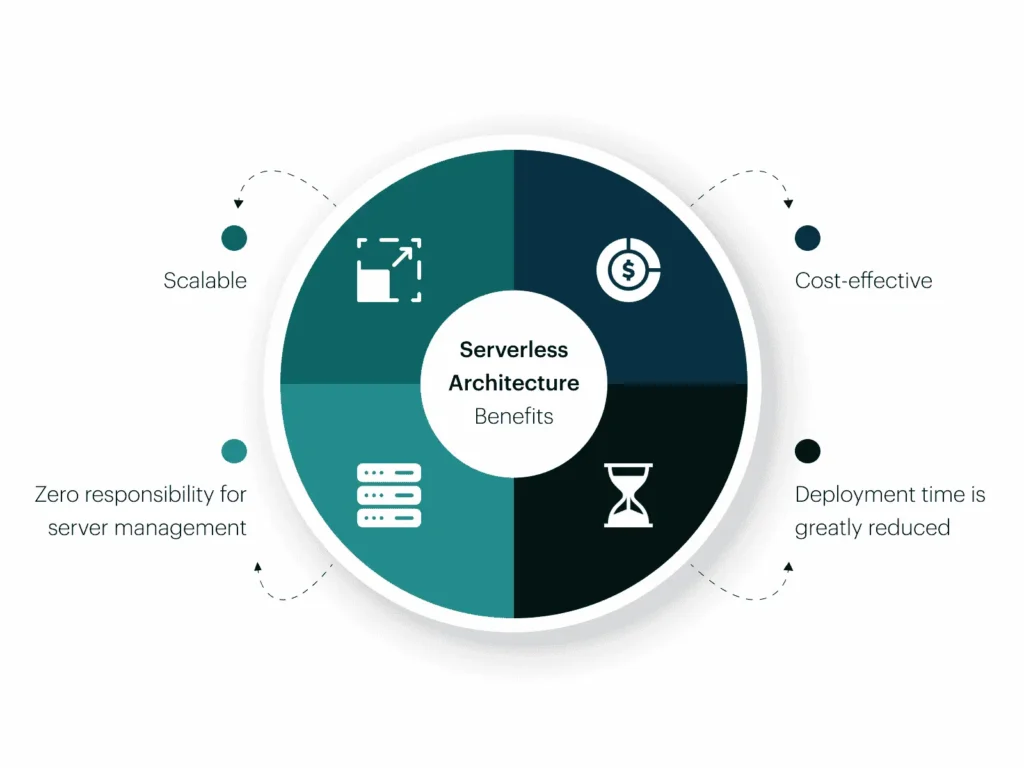
Zero Idle Capacity Costs: With traditional servers, you pay for them 24/7, even when they are idle (e.g., overnight). With serverless, you pay only for the compute time you consume, down to the millisecond. If your code isn’t running, your compute cost is zero.
-
Granular Billing: You are billed for the number of requests and the duration of each execution. This is exceptionally efficient for applications with sporadic or unpredictable traffic patterns, which is the reality for most early-stage startups.
-
Reduced Operational Overhead: The cost savings extend beyond cloud bills. By eliminating server management, startups can operate with a leaner team, allowing developers to focus on product development instead of infrastructure maintenance.
B. Built-in, Automatic Scalability
Serverless architectures are inherently elastic. The cloud provider automatically scales the number of function instances in response to the rate of incoming events.
-
From Zero to Millions: If a marketing campaign goes viral and traffic increases a thousand-fold, the serverless platform will automatically provision the necessary capacity to handle the load without any intervention from the development team. There is no need to pre-provision “just in case” or engage in frantic scaling exercises.
C. Accelerated Time-to-Market and Development Velocity
Speed is a startup’s greatest weapon.
-
Microservices Made Simple: Serverless functions are a natural fit for a microservices architecture. Each function can represent a single service (e.g.,
ProcessPayment,SendWelcomeEmail), enabling small, autonomous teams to develop, deploy, and scale their services independently. -
Simplified Deployment: The deployment process is streamlined to uploading code. Tools like the Serverless Framework and AWS SAM abstract away cloud-specific configurations, allowing developers to define their entire application in a single configuration file and deploy it with a single command.
D. Enhanced Reliability and Built-in Fault Tolerance
Cloud providers manage the serverless runtime environment with high availability and fault tolerance built-in.
-
Automated Maintenance: The cloud provider handles all operating system patches, security updates, and infrastructure maintenance, ensuring the underlying platform is always secure and up-to-date.
-
Built-in Redundancy: Functions are typically run across multiple availability zones by default, providing resilience against data center-level failures without any extra configuration.

D. Addressing Common Challenges and Strategic Considerations
While powerful, serverless is not a silver bullet. A successful implementation requires awareness of its unique challenges.
A. Cold Start Latency
A “cold start” occurs when a function is invoked after a period of inactivity. The platform must provision a new container, load the code, and then run it, which can add several hundred milliseconds to a few seconds of latency.
-
Mitigation Strategies:
-
Keep Functions Warm: Use a scheduled ping (e.g., with CloudWatch Events) to invoke the function every few minutes to keep it in a warm state.
-
Optimize Package Size: Minimize the size of your deployment package by excluding unnecessary dependencies to reduce initialization time.
-
Provisioned Concurrency: Services like AWS Lambda offer Provisioned Concurrency, which initializes a requested number of execution environments so they are ready to respond immediately.
-
B. Vendor Lock-In Concerns
Adopting a provider’s serverless ecosystem (e.g., Lambda, API Gateway, DynamoDB) can create a tight coupling to that cloud platform.
-
Mitigation Strategies:
-
Adopt the Serverless Framework: This open-source tool provides an abstraction layer that makes it easier to deploy to different clouds, though the underlying services will differ.
-
Use Cloud-Agnostic Design Patterns: Architect your application with clear separation of concerns, keeping the core business logic as cloud-agnostic as possible and isolating provider-specific integrations.
-
Weigh the Trade-Offs: For most startups, the immense speed and cost benefits of using deeply integrated, managed services far outweigh the theoretical risk of vendor lock-in in the early stages.
-
C. Debugging and Monitoring Complexity
The highly distributed and ephemeral nature of serverless functions can make traditional debugging methods difficult.
-
Mitigation Strategies:
-
Structured Logging: Implement comprehensive and structured logging (e.g., using JSON) for every function.
-
Leverage Specialized Tools: Use cloud-native tools like AWS X-Ray for distributed tracing and services like Datadog or Lumigo that are specifically designed for monitoring serverless applications.
-

E. A Practical Blueprint: Building a Startup Application with Serverless
Let’s conceptualize a typical startup application—a content sharing platform—using a serverless architecture.
A. Component Breakdown
-
User Authentication:
-
Service: Amazon Cognito. A fully managed user identity and data synchronization service. It handles user sign-up, sign-in, and access control.
-
-
API Layer:
-
Service: Amazon API Gateway. Provides a RESTful API endpoint for all client requests (e.g.,
POST /posts,GET /posts).
-
-
Business Logic:
-
Service: AWS Lambda.
-
CreatePostFunction: Triggered byPOST /postsfrom API Gateway. Validates input and writes to the database. -
GetPostsFunction: Triggered byGET /posts. Fetches posts from the database. -
ProcessImageFunction: Triggered automatically when a user uploads an image to an S3 bucket. It uses a library to create a thumbnail.
-
-
Data Layer:
-
Service: Amazon DynamoDB. A fast and flexible NoSQL database that scales seamlessly with the application’s read/write traffic.
-
-
Frontend:
-
Service: A Single-Page Application (SPA) built with React/Vue.js, hosted on Amazon S3 and distributed globally via Amazon CloudFront.
-
B. Cost Analysis of this Architecture
-
API Gateway: ~$3.50 per million requests.
-
AWS Lambda: ~$0.20 per million requests + $0.0000166667 per GB-second.
-
DynamoDB: Pay-per-request pricing: ~$1.25 per million read requests, $0.25 per million write requests.
For a startup with 10,000 active users performing a few actions per day, the monthly backend compute and database cost could easily be under $10, a game-changing proposition.
F. A Strategic Roadmap for Startup Adoption
Transitioning to serverless requires a thoughtful approach.
A. Start with a Non-Critical Workload
Begin by building a new, discrete feature using serverless. Ideal candidates are asynchronous tasks like data processing, image/video manipulation, or sending batch notification emails. This allows the team to gain experience without risking the core application.
B. Invest in Learning and Best Practices
-
Encourage the team to learn about serverless design patterns (Event Sourcing, CQRS).
-
Implement Infrastructure as Code (IaC) from the start using the Serverless Framework or AWS CDK to ensure reproducible and version-controlled deployments.
C. Embrace a DevOps Culture
Serverless blurs the line between development and operations further. Developers now have more control over deployment and monitoring, necessitating a collaborative DevOps mindset.
G. Conclusion: The Serverless First Mandate for Modern Startups
For startups operating in a climate of extreme uncertainty and competition, serverless architecture is more than just a technological choice; it is a strategic business decision. The profound benefits of radical cost optimization, automatic scaling, and accelerated development velocity provide a formidable advantage, allowing founders to stretch their runway, iterate faster based on user feedback, and scale seamlessly when growth arrives.
While challenges like cold starts and vendor lock-in require consideration, the tools and strategies to mitigate them are mature and readily available. By adopting a “serverless-first” mindset, startups can redirect their finite resources from managing infrastructure to solving customer problems and delivering innovative features. In the relentless race to build the next great company, serverless computing is not just an option—it is the ultimate enabler, providing the technological foundation for agility, efficiency, and unstoppable growth.